Minor Key Revisited
Introduction
Week 11 is now here. In this lesson we will be talking about minor key music. We will be looking first at the functional groupings in minor key music involving the natural, harmonic, and melodic minor scales. Then we dig into the harmony from the Dorian and Phrygian modes. We'll also analyze four songs that use minor key harmonies and the techniques that are used.
This is also the week that you will need to start thinking about your Final Project. This will be due at the end of the course.
Objectives
By the end of the lesson, you will be able to:
understand functional groupings in minor key music involving the natural, harmonic, and melodic minor scales
understand, recognize, and employ common chords from the Dorian and Phrygian modal sources in minor key music
understand all of the available harmonic options in minor tonality
see many minor key harmonies in common practice
understand and comment on how a selection of professional composers decide when a composition is completed
The Saddest of All Keys: A Review of Minor Key Functions
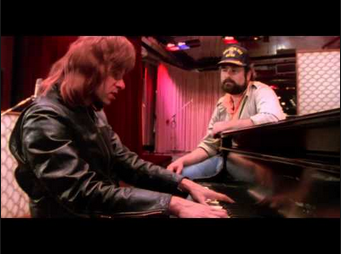
Berklee Trustee Christopher Guest (as Nigel Tufnel) demonstrates D minor “the saddest of all keys.”
The concept of functional groups of chords—tonic, subdominant, and dominant has been a recurring theme throughout these courses. The concept isn't difficult to grasp within the context of a major key. But in a minor tonality, the regularly occurring chromatic tones that are considered diatonic (
Natural Minor or Aeolian Harmony
Working with just the notes of the natural minor scale, we can establish three distinct groups of chords that will create a sense of progression. The tonic function is the most stable of the three functional groups. It functions as home base in the key. The tonic family is inclusive of those chords that include the scale degrees 1,
Tonic Function Group:

The subdominant group is more or less defined by scale degree
Subdominant Functional Group:

The absence of a leading tone in the natural minor scale means that the scale lacks a true dominant function chord. However, there are a few chords that are different enough from both the tonic and subdominant function chords in sound that they will create the necessary polarity for harmonic cadences.
Modal Cadence Chord Group:
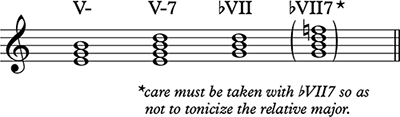
V- and V-7 are valuable as cadence chords because their roots are a perfect 5th above the tonic. The V-7 chord contains a dissonant minor 7th interval which has the tendency to contract to the root and third of the I- chord. This gives it just a little more power as a cadential chord than the V- triad.
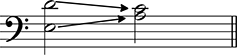
The
The chord scales for each of these harmonic functions are derived directly from the source. Each chord scale is a mode of the natural minor.
Function |
Chord Scale |
Tensions |
Harmonic Avoid Notes |
I- |
Aeolian |
T9 and 11 |
s |
II-7 |
Locrian |
T11 and |
s |
|
Ionian |
T9 and 13 |
s4 |
IV- |
Dorian |
T9, 11, and 13 |
|
V- |
Phrygian |
T |
|
|
Lydian |
T9, |
|
|
Mixolydian |
T9 and 13 |
s4 |
"Sometimes I Feel Like a Motherless Child" Natural Minor Harmonization
The following is a harmonization of the spiritual "Sometimes I Feel Like a Motherless Child." The chords are drawn solely from the resources of the natural minor scale.
At a moderately slow tempo, the 10 measure melody groups naturally into five two-bar phrases both melodically and harmonically. In the first phrase the tonic harmony is stated and prolonged by the inversion, in the second, IV- moves to I- in a plagal cadence. In phrase three,
Harmonic Minor Harmony
In the harmonic minor scale, the tonic chord is once again I-. While I-maj7 is an option, it's probably best to think of the triad as the primary tonic chord. If a varied bass note is called for, a first inversion tonic triad is best. The
Tonic Function Group:

Subdominant chords are identical to the natural minor collection: IV-, IV-7, II-7
Subdominant Function Group:

The harmonic minor material provides a leading tone and with it a true dominant sound. The dominant functional group consists of V, V7, VIIº, and VIIº7. The dominant function chords provide us with the possibility of true tonal (rather than modal) progressions.
Dominant Function Group:

The chord scales for each of the following harmonic functions are derived directly from the source. Each chord scale is a mode of the harmonic minor scale.
Function |
Chord Scale |
Tensions |
Harmonic Avoid Notes |
I-(Maj7) |
Harmonic minor |
T9 and 11 |
s |
|
Ionian augmented |
T9 and 13 |
s4 and |
V7 |
Mixolydian |
( |
s4 |
VIIº7 |
Mixolydian ( |
T |
s |
All other functions derive their chord scales from the natural minor source.
"Sometimes I Feel Like a Motherless Child" Harmonic Minor Harmonization
Here is "Sometimes I Feel Like a Motherless Child," this time harmonized with chords exclusive to the harmonic minor collection.
In phrase one, the tonality of A minor is clearly confirmed by a full dominant cadence. Phrase two offers the contrast of beginning on the subdominant IV- chord and then once again cadences fully to I-. Phrase three offers the contrast of an ascending stepwise bass line that alternates tonic and subdominant colors. Phrase four returns to the tonic, ending in a subdominant half cadence. Phrase five offers a lot of harmonic motion, the VIIº7 chord provides a lift to the melodic pickup to tonic. The phrase then concludes with the cycle 5 strength of a full minor jazz cadence.
Melodic Minor Harmony
The melodic minor collection with its raised 6th and 7th degrees is designed consciously to mimic the harmonic resources of the major scale as closely as possible. Since the only thing that distinguishes the melodic minor from the major scale is the
Tonic Function Group:

The Subdominant Group Is Based on Scale Degrees 2 and 4:

And 5 and 7 Are the Roots Associated with the Dominant Function Group:
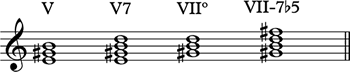
The chord scales for each of the following harmonic functions are derived directly from the source. Each chord scale is a mode of the melodic minor scale.
Function |
Chord Scales |
Tensions and Avoid Notes |
Harmonic Avoid Notes |
I- |
Melodic minor |
T9, 11, and 13 |
|
II-7 |
Phyrgian natural 13 |
T11 and 13 |
|
|
Lydian augmented |
T9 and |
s |
IV |
Lydian |
|
|
VI-7 |
Locrian natural 9 |
T9, 11, and |
|
VII-7 |
Super Locrian |
T11 and |
s |
V7 in the minor key is almost exclusively derived from the harmonic minor source.
"Sometimes I Feel Like a Motherless Child" Melodic Minor Harmonization
A third harmonization of "Sometimes I Feel Like a Motherless Child" shows the vocabulary of the melodic minor collection applied exclusively.
The distribution of tonic, subdominant, and dominant functions in this version of the tune is not all that different than in the second. The notable thing about the melodic minor scale is the bright timbres that are created by scale degrees 6 and 7 in relation to 
Composite Minor Scale Harmony
In common practice, none of these collections—natural, harmonic, or melodic minor, is used very often as the exclusive source of harmony in a single minor key composition. Composers use colors from all three collections (as well as chords from other modes that we'll discuss later in the lesson). Theorists refer to this as the composite minor scale.

"Sometimes I Feel Like a Motherless Child" Composite Minor Harmonization
Here's "Sometimes I Feel Like a Motherless Child" one final time, harmonized with tonic, subdominant, and dominant functions from all three sources as well as cadence chords from the natural minor or Aeolian scale.
Having this knowledge gives the composer the option to create a functional tonal chord progression and to include a wide variety of shades of color within the minor tonality. Listen carefully to the alternation of dark to bright tonic color in m. 2 and the change from bright to darker subdominant color in m. 3. Phrase three makes use of only subdued natural minor color while phrase four employs very bright tonic and subdominant colors. Notice the use of the IV7 chord in the final cadence in phrase five. This brings a different twist to the familiar cadential pattern: iv-V7-i. The composite minor scale also allows for strong descending chromatic motion to help energize the chord progression. Note the descending chromatic bass line in phrase one and the alto line in the phrase five.
The Expanded Harmonic Options of the Composite Minor Scale
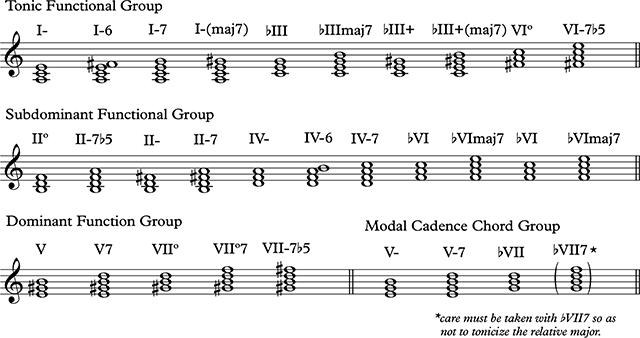
Let's revisit the idea of tonic, subdominant, and dominant functional groups from the perspective of the composite minor scale. The tonic options are now all of the chords built on 1,
Summary
-
Harmony in the minor key can be drawn exclusively from one of three source scales:
Natural Minor or Aeolian
Harmonic Minor
Melodic Minor
Within each scale, the functions belong to the tonic, subdominant, or dominant (modal cadence chord group).
The chord scales for each function are drawn from the natural minor source or in the case of those chords that contain scale degrees 6 or 7 from the melodic or harmonic minor source.
The three sources combine to create the composite minor scale. Within the composite minor scale the tonic options are all of the chords built on 1,
Understanding functional groupings allows the composer to create clear functional progressions while taking advantage of the shading that each variant offers.
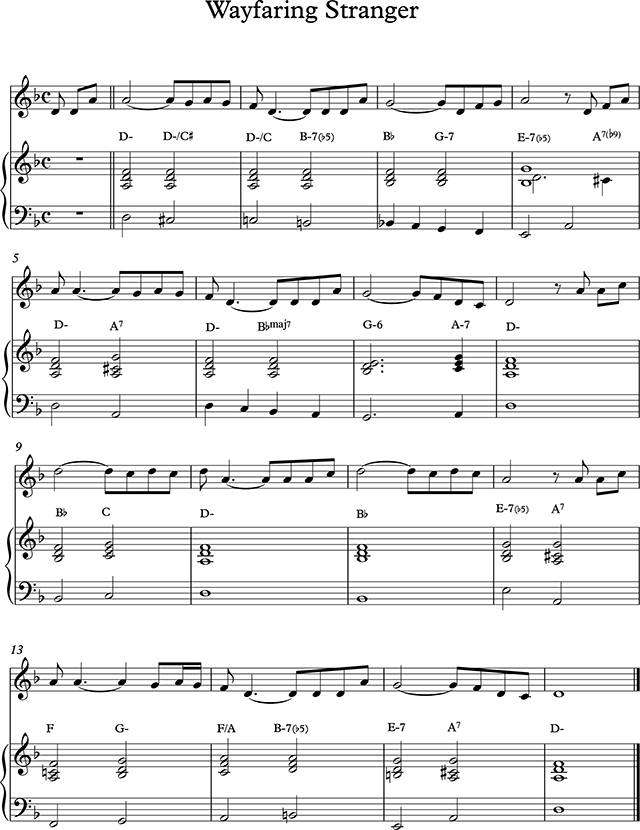
Workshop: "Wayfaring Stranger" Harmonization
Download the lead sheet for "Wayfaring Stranger." Harmonize the melody with a variety of tonic, subdominant, modal cadence, and dominant function chords. Pay close attention to the melody/harmony relationship, taking care with harmonic avoid notes. Try to use the three basic tonal sentences: Tonic-Dominant-Tonic, Tonic-Subdominant-Tonic, or Tonic-Subdominant-Dominant-Tonic as you harmonize the melody. Compare your version to the example below. Please note that there are many possible outcomes.
Download "Wayfaring Stranger" lead sheet (PDF)
Light and Dark: Dorian and Phrygian Modal Choices in Minor Key Music
Control of color is so important for all artists. For the composer, employing just the right shade of harmonic color can affect both the mood and emotion of the listener in dramatic ways. This topic will deal with further modal colors in the minor tonality.

Light and Dark
Although the natural minor scale, the scale of the key signature, is the starting point for thinking about minor key harmony, we have seen how most minor key music contains chords from other sources as well. In the previous topic we identified the tonic, subdominant, and dominant functional families from the natural minor, harmonic minor, and melodic minor source scales. Additionally, we identified modal cadence chords from the natural minor source which are used commonly. In this topic we will continue to expand the possibilities of minor key harmony by investigating the colors available to us from the Dorian and Phrygian modes. These modes are considered minor scales because they each have a minor tonic triad.
Dorian Minor Harmony
Consider the following musical examples:
1. Straight 8ths
2. Swing
They are both clearly minor in character, but they project a different mood than other minor chord progressions that we have studied up until now. How would you characterize that sound? Cool? Jazzy? The sound of '60s and '70s pop, perhaps?

Light and Dark
Dorian Scale
The Dorian scale is another important source for tonic function chords in minor key.
Dorian Minor Source Scale:

Similar to the melodic minor scale, in that it has a raised scale degree 6, it lacks the leading tone or raised 7 that the melodic minor scale also has. Because of this, the Dorian scale occupies a place on the spectrum of color between the natural minor and melodic minor scales.
Its
C Dorian: The Chord Scale for I-6 and I-7 in C minor:

I–6 is a variation of I–7.
1. Dorian Melody
2. Melodic Minor Melody
In this instance, the melodic minor melody sounds quite contrived, but the Dorian melody feels much more natural against the C-6 harmony. The downward melodic tendency of

Check out this Spotify playlist of popular songs in the Dorian mode. You may recognize the first two songs from the first examples we examined.
Other Tonic Options with Dorian Minor
VI-7
The
Using the
With both VI-7
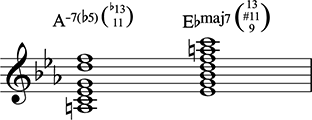
Summary of Tonic Function Chords Provided by the Dorian Source Scale
The Dorian source provides us with a number of different tonic function possibilities: I-, I-6, I-7,
While all of these chords are available in other source scales, it is the particular combination of scale degrees 6 and 7 that makes this a distinctive sound, both harmonically and melodically.
A Brighter Minor Subdominant
The Dorian mode is also the source of three colorful minor-key subdominant chords: II–7, IV6, and IV7. IV6 is essentially II–7 in first inversion, but it is often written as a root position chord in popular styles.

Subdominant chords derived from Dorian are viable in minor key harmony because of their similarity to major key subdominant chords. They bring a hint of major key brightness into a minor key progression without disturbing the overall mood.
The Dorian source scale provides only tension 11 for II–7.

The Dorian source scale produces tensions 9 and 13 on IV7. S4 is avoided in chord voicings.
Compare Dorian with Melodic Minor

As we saw previously, the melodic minor scale also offers the options of II–7 and IV7. Because of the inclusion of the leading tone, the tensions are slightly different than the same chords from a Dorian source.

As you might imagine, it is important to think in the context of a particular source scale when using these chords in the minor key. When handled skillfully, they provide the composer with a varied palette of colors. And as the saying goes, "variety is the spice of life!"

The Phrygian Source: A Darker Subdominant Chord
Compare these two passages:
Passage 1.
Passage 2.
The first excerpt, as you can see, uses the subdominant Dorian scale as the source of its harmony, the second sources Phrygian. How would you compare the sound of the two passages? Which is the brighter in mood? Which is the darker of the two?
The Phrygian mode is the source of another, less common subdominant function chord:


The tensions associated with

Dark Light
The
Summary of Subdominant Function in Minor Key Music
Here's a summary of subdominant funtion in minor key music:
Aeolian is the primary source of minor key subdominant chords
The
IV–7 is the primary subdominant in minor key music
II-7
Melodic minor and Dorian produce brighter subdominant chords: II–7, IV6, and IV7
Phrygian produces the darker subdominant
Songs for Further Study
Dorian:
Phrygian:
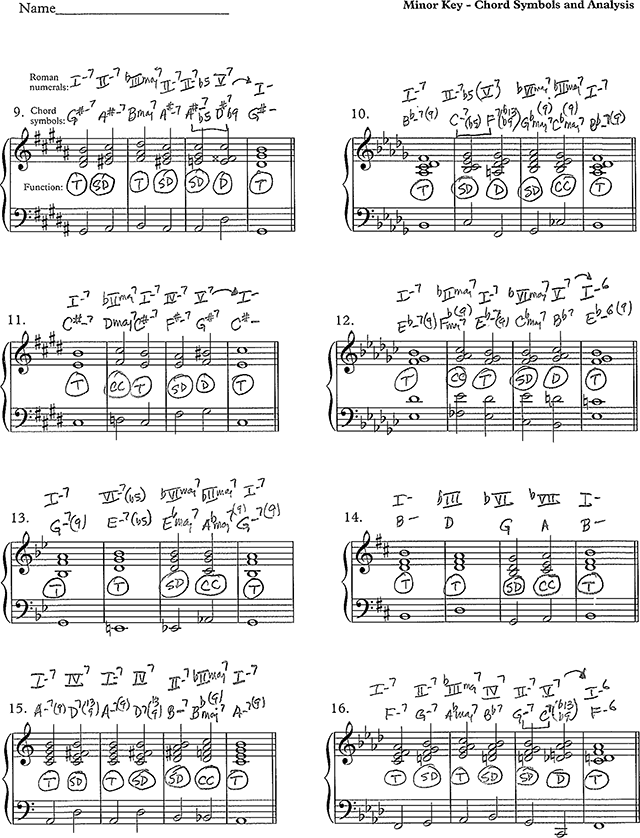
Workshop: Minor Key Analysis
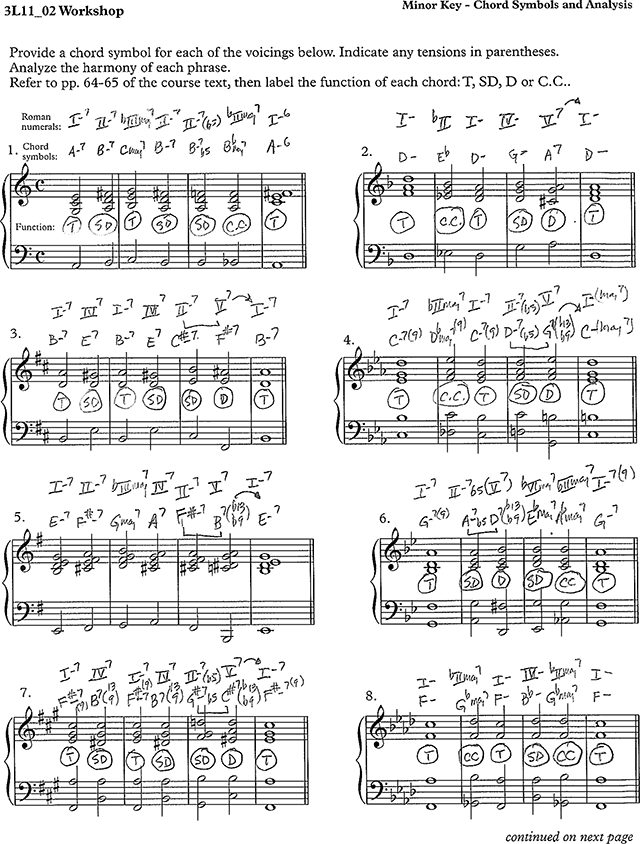
Download the PDF and analyze the chord progressions giving both Roman numeral analysis and functional analysis as directed. Check your answers against the answer key. Be sure to play the exercises on the keyboard so that you can hear them!
Download Minor Key Analysis (PDF)
The Expanded Minor Universe: A Review of the Complete System of Minor Key Harmony

Universe
We have explored a lot of territory up to this point with regard to harmony in minor tonality. From the notes of the key signature—the natural minor or Aeolian scale, to sophisticated chromatic options involving
In this topic we'll present an overview in chart form of all of the minor key materials that are available. You should take the time to commit this material to memory. The workshop will contain a multiple-choice test so that you can check your memory and comprehension of the information. The key to using this material is to organize it mentally around functional categories: Tonic, Subdominant, Modal Cadence, and Dominant Functions. Secondary Function chords: secondary dominants and substitute dominants.
Diatonic Chords: Tonic, Subdominant, and Dominant Function Groups
Tonic Function Group |
||
Chord |
Source |
Tensions |
I- |
All |
Source dependent |
I-6 |
Dorian |
9, 11 |
I-6 |
Melodic |
9, 11, 7 |
I-7 |
Aeolian |
9, 11 (s |
I-7 |
Dorian |
9, 11, 13 |
I-(maj7) |
Harmonic |
9, 11 (s |
I-(maj7) |
Melodic |
9, 11,13 |
|
Aeolian |
9, 13 (s4) |
|
Dorian |
9, |
|
Aeolian |
9, 13 (s4) |
|
Dorian |
9, |
|
Melodic |
9, |
VI-7 |
Dorian |
11, |
VI-7( |
Melodic |
9, 11, |
Subdominant Function Group |
||
Chord |
Source |
Tensions |
II-7 |
Aeolian |
11, |
II-7 |
Melodic |
11, 13 (s |
II-7 |
Dorian |
11 (s |
IV- |
Aeolian |
9, 11, 13 |
IV-6 |
Aeolian |
9, 11 (s |
IV-7 |
Aeolian |
9, 11, 13 |
IV |
Dorian |
9, 13 (s4) |
IV6 |
Dorian |
9, 13 (s4, s |
IV7 |
Dorian |
9, 13 (s4) |
IV7 |
Melodic |
9, |
|
Aeolian |
9, |
|
Aeolian |
9, |
Modal Cadence Chords |
||
Chord |
Source |
Tensions |
|
Phrygian |
9, |
|
Phrygian |
9, |
V- |
Aeolian |
11 (s |
V-7 |
Aeolian |
11 (s |
|
Aeolian |
9, 13 (s4) |
|
Aeolian |
9, 13 (s4) |
|
Phrygian |
11 (s |
Dominant Function |
||
Chord |
Source |
Tensions |
V7 |
Aeolian (+leading tone) |
|
VII-7 |
Melodic |
|
VIIº |
Aeolian (+leading tone) |
7, |
VIIº7 |
Aeolian (+leading tone) |
7, |
Diatonically Related Chords
Secondary Dominants |
|
Chord |
Tensions |
V7/V |
|
V7/IV |
|
V7/II |
|
V7/ |
|
V7/ |
|
Substitute Dominants |
|
Chord |
Tensions |
subV/I |
9, |
subV/IV |
9, |
subV/V |
9, |
subV/II |
9, |
Master the universe! Learn your minor key functions!

You Are Here
Under Close Inspection: Four Analyses of Minor Key Tunes

Detective
In this topic we'll closely analyze four well-known tunes in different styles. Each of them is in the minor mode and employs rich colorful choices from the large vocabulary of chords that we have been discussing in this lesson. You'll have an opportunity to see how each composer has used many different minor key options to create a specific sound in each tune. As you look at each piece, try to notice how the minor key tonality is established. What harmonic sentence does the composer use? Is it SD D T, or T T SD D, or something else, perhaps? How does each composer create harmonic variation? How does each use chromaticism and to what effect?
Jimi Hendrix’s “Little Wing”
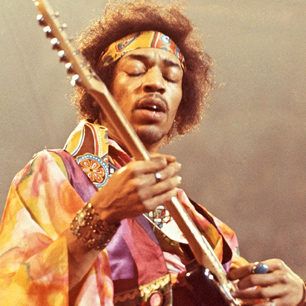
Jimi Hendrix
First off is Jimi Hendrix's "Little Wing" from the album Axis: Bold as Love. In this song, Hendrix uses chords from the Aeolian or natural minor source scale almost exclusively. There are two exceptions: the subV/IV at the end of m. 5 creates a lovely little slide down into m.6. Notice how the
Jimi Hendrix. "Little Wing." from Axis: Bold as Love. (Track/1967).
Sting's “Sister Moon”

Sting
Another interesting minor key tune is found on Sting's album Nothing Like the Sun. "Sister Moon" starts out with a repeated vamp from the melodic minor source scale in F
Sting. "Sister Moon," from Nothing Like the Sun. (A&M/1987).
Bill Evans' “We’ll Meet Again”

Bill Evans
The Bill Evans tune "We'll Meet Again" from the album You Must Believe in Spring, offers a variety of different tonic and subdominant functions. The minor II V cadence is an important device in this piece.
Bill Evans. "We'll Meet Again" from You Must Believe in Spring. (Warner Bros./1979).
Chucho Valdes’ “Claudia”

Chucho Valdés
Chucho Valdes' tune "Claudia" from the Paquito De Rivera album Reunion offers complex minor key harmony. Note the use of the secondary dominants V7/V, V7/IV, V7/
Chucho Valdes. "Claudia" from Reunion. (Messidor/1991).
Scrutinize each of these pieces thoroughly. Notice how the composers use different aspects of minor source harmonies such as natural minor, melodic minor, and harmonic minor to create different moods.
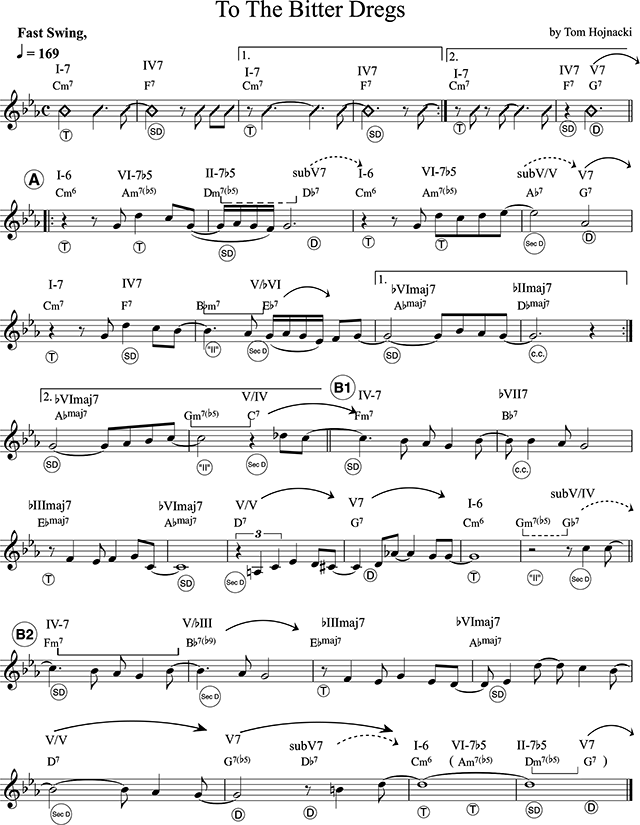
Workshop: “To the Bitter Dregs” Analysis
Analyze "To the Bitter Dregs" and check your analysis against the PDF.
Download To the Bitter Dregs score (PDF)
Composers on Composing: Completing a Composition
In lesson 11, three composers share their thoughts in answering the question:
How do you decide when a composition is done?
Composers interviewed in week 11:
Mark Simos—Singer, songwriter
Michael Wartofsky—Musical theater composer
Julius Williams—Contemporary classical music composer and conductor
Final Scoring Project (Due Lesson 12)
General directions: Compose a piece using AABA, rounded binary (|A|BA'|), or theme and variations form to support a short film entitled Fazi, which clocks in at 2:30. The director (a theory geek) insists that the composition must include a modulation to a distant key (more than one sharp or flat away from the original key), at least one secondary dominant function diminished 7th chord, one modal interchange chord, and one substitute dominant or augmented 6th chord. The director also insists on having a principal motif that is developed using techniques covered in Music Theory and Composition 2's "Melody Corner" topics, that included repetition, diatonic or exact sequence, retrograde, inversion, intervallic variation, and rhythmic variation.
Scenario: Imagine that you have been asked to compose a song or composition to enhance the movie Fazi. The movie is two minutes and 30 seconds in length. Fazi is a somewhat surreal, quirky short film about a young man going through an existential awakening. There is no dialog, so your music will be important in creating the proper mood. Given its length, there is time for a short introduction, and depending on your tempo, one or two times through the form, and a short ending or coda. As with the other scoring assignments, you are not being graded on how well the music fits with the movie, but on the technical aspects of the assignment.
Start by dragging L11_ FinalAssignment.mov into your DAW. As with previous scoring assignments, a demo movie and score (Final Assignment Demo Score) have been provided. All of the instruments used in the demo are GarageBand instruments. Your project must use one of the following short forms: AABA, rounded binary (|A|BA'|), or theme and variations.
Download Final Assignment Movie (MP4)
Download Final Assignment Demo Score (PDF)
Intro and ending: An intro and an ending (coda) are optional, but encouraged. The intro and ending sections should help balance your composition and make it sound more complete.
Arrangement: Minimally, you must have a melody line and chordal accompaniment. If you feel inspired, you may use a larger orchestration and add bass and drums as appropriate. Use a separate staff for each additional instrument.
Style, tempo, and meter: Your composition can be in any of the meters covered in the lessons, or include change of meters. The style and tempo are up to you.
Harmony: You may use any of the harmonic materials covered in this course. You must have a clearly-marked modulation to a distant key (more than one sharp or flat away from the original key), at least one secondary diminished 7th chord, and one substitute dominant or augmented 6th chord.
The score: The score may be handwritten or created in notation software. The final score should have no section repeats or individual measure repeats. Use rehearsal letters to indicate the form. Use measure numbers centered under the bottom staff.
Notation: Follow all notational guidelines set forth in the class, i.e. clef, key signature, meter, stem direction, beaming (use a straight edge for four beamed eighth notes or sixteenth notes beamed on one beat and long barlines), connector bar line, bar line, double bar lines, fine bar line, accidentals, chord symbols, alignment, instrument names, etc. Voiceleading for the chord instrument: Use one of the accompaniment styles presented in the course. The voiceleading may be chordal or in arpeggiated style.
Analysis: Put the Roman numeral analysis above the chord symbols. Use contemporary (upper case) Roman numerals.
Add a title, tempo, style, and lyrics (if applicable).
Recording: The recording should reflect all parts accurately, including exact pitch and octave.
Special note for MIDI: Be sure to transpose bass pitches appropriately, as well as guitar, if used. Both of these instruments sound one octave lower than where written. Also, keep your chord instrument within the following range: E3 to C5. Try to keep voicings in a lower range than melody, when possible.
Your work will be evaluated on the following criteria:
Your project is turned in on time with the required file(s) and score.
Meeting project requirements.
Preparation of the score.
Accurate recording of your score.
Recap
In this lesson you learned:
the functional groupings in minor key music involving the natural, harmonic, and melodic minor scales
how to understand, recognize, and employ common chords from the Dorian and Phrygian modal sources in minor key music
to understand all of the available harmonic options in minor tonality
how four pieces use minor key harmonies in common practice
how several professional composers decide on how they know a composition is completed
In our final week coming up, we'll be diving deeper into the blues by looking at further options of the 12-bar minor blues and exploring new forms.